
Lessons from Portland’s Community Roundtable
by Kabri Lehrman-Schmid
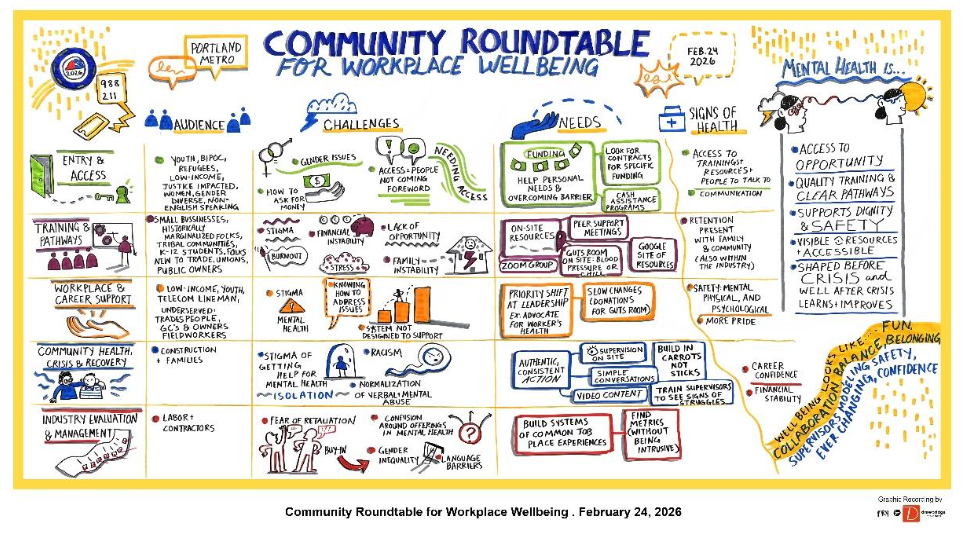
In February, more than 70 professionals representing over 45 organizations gathered in Portland, Oregon, for a Community Roundtable on Workforce Wellbeing. Held in conjunction with the Construction Mental Health & Wellbeing Conference, this pilot event intentionally brought together local organizations that directly serve the construction workforce - including labor, contractors, educators, community-based organizations, and health and recovery providers.
As a Board Member of the Construction Industry Alliance for Suicide Prevention, I had the opportunity to moderate the discussion. What made this roundtable different wasn’t just who was in the room – it was the deliberate focus on voices closest to the workforce experience. These weren’t abstract perspectives. They were real insights from organizations working with our workforce every day.
We also approached the conversation with a wider lens. Mental health doesn’t exist in isolation. Workforce wellbeing is shaped by the conditions people experience every day. And when those conditions break down, the impact doesn’t stop with the individual. It shows up in families, on crews, and across companies.
A few things became very clear.
Key Findings from Portland
1. Workforce wellbeing is fragmented – but deeply resourced at the local level
Organizations providing recovery services, culturally competent care, and workforce access programs are actively supporting construction workers but often without direct connection to employers or jobsites.
What this means:
We don’t necessarily need more programs. We need to better connect and make visible the ones already doing the work.
2. Entry into the industry is a critical moment for connection to support
Pre-apprenticeship and training organizations shared that many workers enter construction without awareness of available support - despite facing immediate challenges like housing, transportation, and financial stability.
What this means:
If we’re serious about workforce wellbeing, it has to start at entry (not after something goes wrong).
3. Jobsite culture determines whether resources are used
Contractors and workforce advocates were clear: even when services exist, workers won’t use them unless the jobsite environment supports it.
What this means:
Mental health outcomes are shaped every day by how we plan work, lead crews, and set expectations on our jobsites.
4. Community-based organizations are trusted – but under-integrated
Organizations serving LGBTQ+, immigrant, and culturally specific communities are often trusted sources of support yet are rarely connected to employers or project teams.
What this means:
If we want to reach the full workforce, we need stronger, more intentional partnerships with the organizations workers already trust.
5. Prevention requires alignment – not parallel efforts
Service providers and workforce organizations often operate alongside the construction industry - not in coordination with it - leading to missed connections and gaps in support.
What this means:
Improving workforce wellbeing requires alignment. The industry and the organizations serving our workers have to be working together, not next to each other.
Why This Matters
What we saw in Portland wasn’t a lack of resources. It was a lack of connection.
Improving workforce wellbeing means addressing not just mental health, but the conditions that shape it—and the people impacted when those conditions fail.
And that work is already happening. It’s just not always connected.
What Comes Next
This roundtable was just the beginning.
The next step is to strengthen these connections so that support is not just available, but accessible, trusted, and used.
In our next post, we’ll share how this conversation was designed and how other regions can build on this model.